


Sean MacDermott had written off motion
Vincennes University had been running legacy fixed-base devices with a motion option, and it had not worked. The motion lagged, it did not feel right so they stopped using it. He and his colleague Jason agreed the matter was closed.
Then he flew a RealSimGear SR7x Pro on a motion platform, pulled the CAPS handle, and forgot what he was supposed to do next.
"I flew that simulator and pulled the parachute on it for the first time and got so distracted by all of the motion and getting pulled back into your seat by the seat belt and everything else that I totally forgot to follow through on the rest of my procedures after pulling the handle. That's kind of when I went, okay, I'm rethinking this motion thing."
— Sean MacDermott, Vincennes University
Vincennes is now standing up a six-device lab with RealSimGear simualtors and all but one of those devices sits on a motion platform.
What Vincennes installed
-
Four SR7x Pro simulators for the Cirrus SR20 G7, including one desktop unit and two on 6 DOF motion platforms
-
One PSx Pro Piper Seminole simulator, built to order, on a 6 DOF motion platform
-
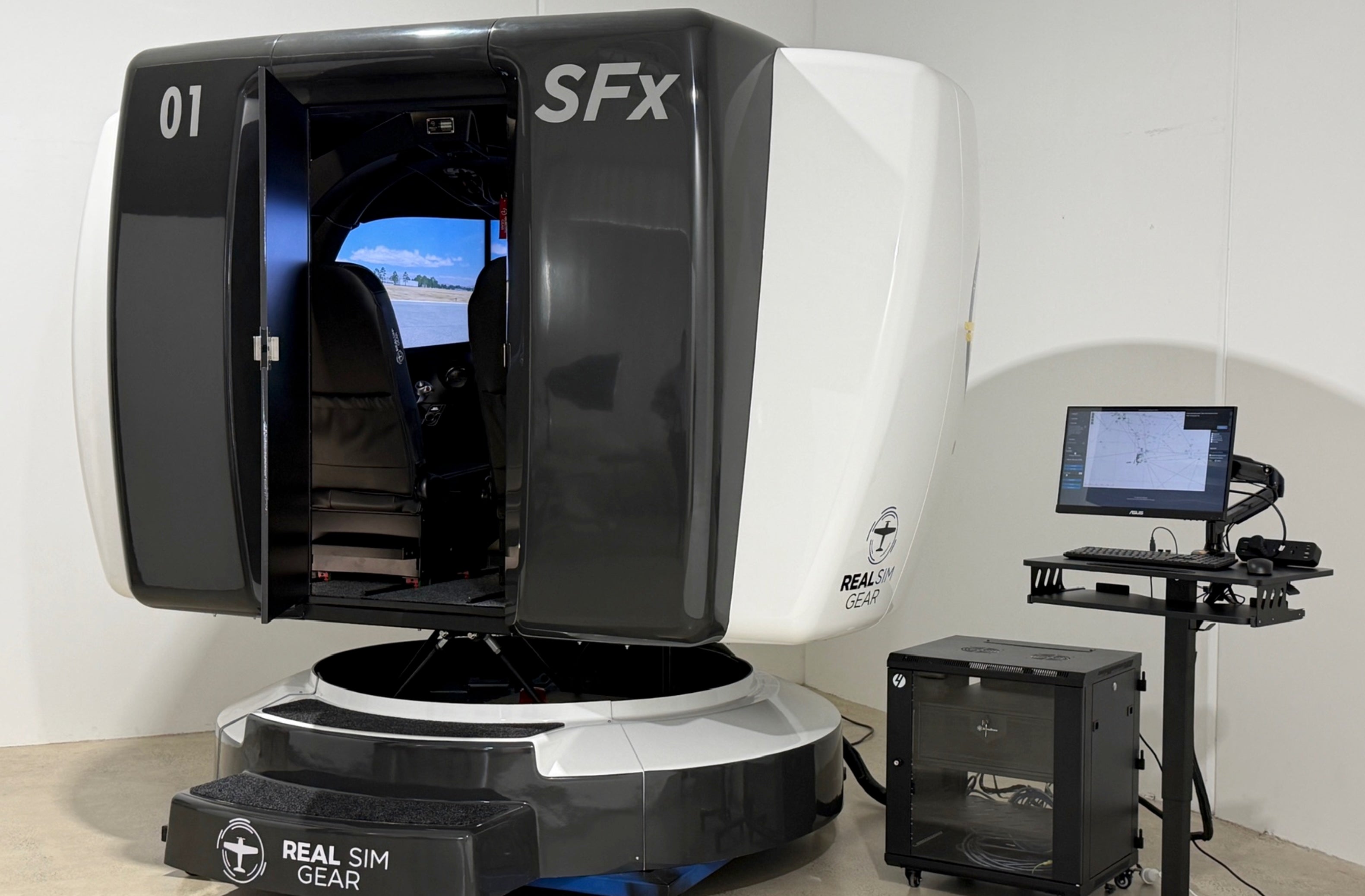
One SFx Premier Cirrus SF50 Vision Jet simulator for the college's Crew Resource Management course
The fleet drove the count. Vincennes flies nine Cirrus G7 SR20s, and the program wanted roughly half that many simulator stations to cover demand.
The fixed-base SR7x Pro AATD has been in service for just over half a year. Close to ten instrument pilots have now done the bulk of their logged simulator training on it.
Why they replaced their legacy simulators
The trigger was a fleet upgrade, not a simulator failure.
Vincennes moved its aircraft fleet to the Cirrus SR20 G7 series. The existing simulators were still emulating a G3-era panel on with outdated software, with no touchscreens. Reliable, but nothing like the aircraft the students were about to fly.
"We were already having issues with students complaining about the old sims being extremely different from the airplanes. Because of that, we had to hold back on the number of hours we put in simulators. We've got these machines in this room and we just can't really use them, because the students don't believe in them."
Once the students stopped believing the devices, the hours came out of them and went back into the airplanes. A room full of simulators became a line item that was not earning anything.
When the incumbent vendor's roadmap came back as slightly larger screens on the same panel, Vincennes started looking elsewhere.
What they evaluated
Vincennes is a state institution, so it ran a full comparison.
The higher-tier vendors were priced out of reach on both purchase and upkeep. That pushed the search down to the ATD level.
"The cost of upkeep and even the initial purchase was just astronomical. It would be great if we had that kind of money, but that's not the kind of institution we are. So we were looking for something more on the ATD level that was pretty close to a Cirrus."
Two vendors made the shortlist. One of them impressed on hardware and lost on software.
"The build quality on their machines is phenomenal, the stuff is just steel clad. The software just was not there. When I pressed a procedure, the right menu didn't pop up. When I checked my flight plan, it didn't look like the flight plan I'm used to. This is basically like going back to [where we started] again. We're going to have machines that have different avionics than our airplanes."
The RealSimGear evaluation came down to one thing.
"Every button we pressed did the right thing. The things that didn't work were grayed out, and nothing was really critical, but you knew what would work and you knew what didn't. When you press the buttons, pretty much the same thing happens on those screens as in the real airplanes. That was really critical to us."

RealSimGear SR7x Pro with dual seats and controls
What motion actually does
A motion platform reproduces the onset of an acceleration, not the sustained force that follows it. Nobody at Vincennes bought it expecting sustained G. What changed Sean's mind was not realism. It was the distraction factor.
"Maybe it's not about the realism, but the immersion, and the fact that it offers its own distraction, which is extremely realistic and very much like the experience that you're going to have in airplanes."
On instruments, that distraction is the lesson. A fixed-base device cannot give a student the false physical cue that instrument training exists to overcome.
"You can feel everything in the airplane, the seat of the pants, knowing your coordination, especially when you're on instruments, when what you're feeling is wrong and you have to trust your instruments. That's where the value is for me. You get them in an uncoordinated situation, you put them in turbulence, and they react to their sensations instead of the flight instruments. That's a distraction, but it's a successful one, where the immersion has reached a level where they now have to tell themselves, no, focus on your instruments."
On the Seminole, an engine failure is felt before it is seen.
"The first five minutes I was on that simulator, I had Rob pull back one of the engines on me, and I just felt my foot going forward almost before I saw any indications. I guess I kind of cheated a little bit, I knew there was something coming. But as soon as that thing started to yaw and roll a little bit, the reaction was just automatic. That's exactly the kind of thing we're looking for."
The cue reached him through the airframe before it reached him through the panel. That is the order it arrives in the aircraft, and the order a multi-engine student needs to practice.
Six months on emulated avionics
Close to ten instrument pilots have now trained primarily on the device. Sean's summary of their feedback: "It's not really any different than flying in the airplane." Panels look like the aircraft, flight plans build, procedures fly, and the navigation database matches. Where a procedure has been wrong, Vincennes has called and had it corrected.
Our avionics emulation is under active, ongoing development, and support for the deeper flight plan editing functions continues to expand with each release. Vincennes came across a bug when modifying a flight plan mid-session, exactly the kind of feedback that makes the product better. It's already with RealSimGear's development team and is being addressed in the current development cycle.
There are also significant benefits with emulated avionics when it comes to maintenance.
"The benefit with the emulated avionics is obviously cost. We're not buying and maintaining line replaceable units and replacing them at a cost of ten grand each time we lose a component here or there." A physical-avionics device carries the aircraft's maintenance economics into the classroom. An emulated flight deck does not. Over a device's service life, that difference compounds well past the gap in purchase price.
Substantial savings, stronger skills
Vincennes restructured its instrument course around the new devices, and students have found tremendous financial savings by using them. From new students learning Private Pilot maneuvers for the first time to second-year students maintaining currency, the program has seen a substantial increase in flight skills alongside the savings.The restructure was only possible because the program trusted the device.
"We just finished restructuring our instrument course, and several other courses. We did that because we know that we can feel confident putting our students in there for the maximum fourteen hours we get for instrument. Doing forty percent of your training in the simulator is a huge cost saving."
Flight and simulator time is usually coded as a fee, and most financial aid will not cover a fee.
"That's really significant for a lot of these guys. Especially with changes in regulations, they're having even more trouble coming up with financial aid. So anything we can do to reduce costs for them is really important."
Every hour moved from the aircraft to the device lands on the part of the student's bill that aid does not reach.
The open lab
Vincennes staffs its simulator lab with one or two flight instructors, 10am to 3pm Monday through Thursday this semester. Students walk in and fly, at no cost.
"I have a CFI candidate I was working with, close to graduation, and she was having all kinds of trouble doing steep spirals. She'd only really been able to get out and do it once in the airplane. I said, why don't we try it in one of our new simulators? We were able to do about four steep spirals in maybe twenty or thirty minutes, for no cost to her. Versus paying probably close to four hundred dollars to do the same thing in an airplane, and you'd have only gotten half as many iterations. Every time we did it, there was improvement. Big improvement. You look at the instructor station and you can see her circles were tight, right on top of each other, right over the point."
 RealSimGear SFx Premier Motion
Four repetitions in half an hour at no cost, against two repetitions for roughly $400 and a round trip to the practice area.
The lab also changed how the curriculum is sequenced. Before a Vincennes student meets a new procedure in the aircraft, they fly it in the simulator first. Private pilot students spend their first days on the device learning CAPS, the autopilot and the FMS, none of which is a sensible first-time-in-the-aircraft exercise.
The Vision Jet Sim and Crew Resource Management
The sixth device is the one Vincennes is most excited about. Its fully enclosed cabin, 6 DOF motion and dual controls change what the simulator is for; with two seats and two sets of controls, the SFx Premier supports the college's Crew Resource Management course, a requirement for the associates program taking advantage of reduced ATP minimums and the one course where the focus isn't on single-pilot flying. It's a course most programs currently deliver with an instructor role-playing the second seat rather than actually flying it.
Frequently asked questions
How much of an instrument rating can be done in a simulator?
At Vincennes, up to 14 hours per instrument rating are loggable in the device, and the restructured course now puts roughly 40 percent of training time in the simulator. Those are two separate figures. The exact loggable allowance depends on the device's FAA Approved AATD approval and the program's approved curriculum.
What does simulator time cost compared to aircraft time?
At Vincennes, the standard rate is $75 per hour in the simulator against $230 per hour in the aircraft. Those are their rates to their own students, and they will vary by program and region.
Do you need motion in an ATD?
Not for every training objective. Motion earns its place in instrument work, where it supplies the false physical cue or distractions a student must learn to override, and in multi-engine work, where an engine failure needs to be felt. A motion platform reproduces the onset of an acceleration, not sustained force. Buy it for cue realism and distractions, not for G.
How do emulated avionics compare to real Garmin units?
For the great majority of training tasks they behave the same, which is what Vincennes reports after close to ten instrument pilots. The deepest flight plan modifications are not fully supported yet, but new features are being deployed all the time. There is a real advantage in maintenance: no line replaceable units to replace at roughly $10,000 each, space parts are easy to keep on hand.
Are RealSimGear devices FAA Approved?
Many RealSimGear simulators are FAA Approved as AATD and BATD training devices. See specific product pages or contact us for FAA approval status for particular products. Learn more HERE
Who else trains on RealSimGear devices?
RealSimGear devices are in use across 84 countries and 90 flight schools/training centers, including collegiate programs at Texas Southern University and California Baptist University.
Talk to our team about your program.
Share:
Introducing the RealSimGear SFx Premier